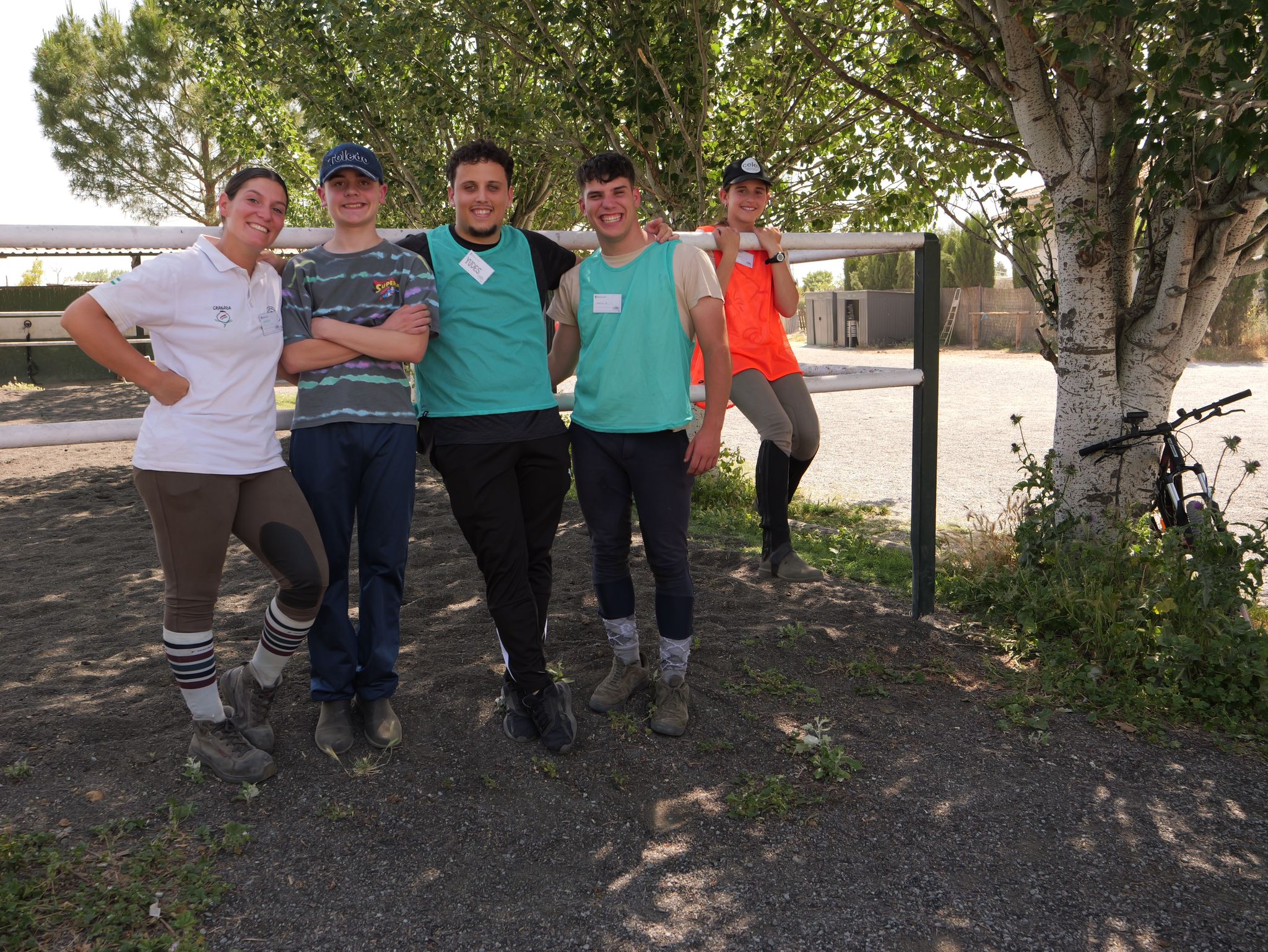
Text: Martin Goldburd, CELEI
Cover photo:: CELEI
Other photos: CELEI
Hugo is 18. He has autism. He loves history. The texture of old stone, the logic of dates, the way a single place can hold ten different centuries at once. What Hugo needs, and what good design can give him, is a set of conditions that let that curiosity breathe: advance information about what to expect, stimuli that reach him through drawing and sound as much as through text, a quest structure segmented into clear steps so that at every moment he knows where he is and what comes next. When those conditions are in place, Hugo is exactly the kind of engaged, attentive explorer that heritage experiences aspire to reach.
Hugo’s experience points to something larger. Across Europe, millions of young people have the curiosity and the will to connect with cultural heritage, yet the formats through which that heritage is delivered were built around a narrow set of assumptions about who the visitor is. Civic Heritage Quest was built on the conviction that design can do better. Doing better means adopting what we call an inclusive lens: a structural commitment to examining who is still missing from each activity at every stage of its design, and to building the conditions that allow more young people to be fully present.
Inclusion is a design question: built one concrete step at a time
Heritage organizations and youth workers consistently describe their programs as open and welcoming and that aspiration is genuine. The most productive next step is to translate that aspiration into diagnosis: asking who is specifically absent, what creates that absence, and what a concrete change would look like. This is the founding logic of the six-dimension inclusion framework that underlies the Civic Heritage Quest approach, drawn from the New European Bauhaus (NEB) Compass and its three cumulative levels of ambition: to include, to consolidate, and to transform (New European Bauhaus, 2021).
The six dimensions (gender, disability, language and origin, education level, family and social network, and contacts and power networks) function as a diagnostic instrument: a structured way of seeing which assumptions the Programme is built on, and which young people those assumptions leave at the margin. Applied to heritage access, each dimension reveals a different layer of the same opportunity.
Six Dimensions, Six Opportunities
Gender shapes who feels safe exploring a public space alone or after dark, who sees themselves reflected in the stories a heritage site chooses to tell, and whose leadership within a youth group gets validated. A heritage quest that widens its narrative lens, asking not only whose military built a fortification, but whose domestic labour and child education made that possible, creates a richer historical picture and reaches a broader range of young people.
Language and origin remind us that a sense of welcome has to be readable. A young person who can find the sign-up form in their own language, who recognizes a cultural reference embedded in a narrative, or who sees their community’s relationship to a heritage site reflected alongside the majority account, arrives with a reason to engage. Multilingual materials and culturally plural narratives are the practical expression of that welcome (Council of Europe, 2005).
Education level becomes an entry point or a threshold depending on how the Programme is designed. Sign-up processes that offer a phone call or a face-to-face option alongside the online form, and activity instructions that are spoken, demonstrated, and kept short, open the experience to young people who left school early or who are NEET, groups whose curiosity about the past is no smaller, and whose need for well-designed entry points is no less urgent.
Family and social network determine whether a young person can realistically get to an activity and sustain participation in it. Predictable schedules, short sessions, and referral links with schools and social services are the practical tools that turn an open door into a reachable one, particularly for young carers or those in precarious housing situations.
Contacts and power networks shape who feels entitled to co-design a cultural experience rather than simply consume it. Building deliberate routes like a guaranteed slot to pitch an idea to a local decision-maker or a peer mentoring structure that connects experienced participants with newcomers, gives young people without institutional connections the same starting position as those who already know how to navigate those spaces.
Hugo’s Dimension: Disability and the right to the full experience
Disability is the dimension that most directly concerns Hugo, and the one where the gap between aspiration and practice is most visible in heritage settings. Physical accessibility like a ramp, a lift or a tactile map is an essential foundation. What depth looks like, beyond that foundation, is asking whether a young person with a physical, sensory, or cognitive disability can take part in the full experience of an activity once they have entered the space (United Nations, 2006).
For young people on the autism spectrum, the barriers are sensory and informational. Heritage environments tend to be unpredictable: acoustic spaces with unexpected amplification, crowd patterns that shift without signal, and narrative formats that reward sustained linear attention in conditions that make that difficult. The design response to each of these is concrete and achievable.
Preparatory materials sent in advance, describing the sequence of stops, the kind of sounds likely at each location or the shape of each task, give Hugo the cognitive map he needs before he arrives, so that curiosity can be his primary mode rather than orientation. Stimuli designed across modalities like drawings that carry the narrative before the words do, ambient music that marks transitions rather than demanding attention and audio clues that complement visual information, reach him where he actually processes content. And a quest structure segmented into short, clearly bounded steps with visible progress indicators means that at every moment there is an anchor: a defined place in the experience, a clear next step, a sense of achievement already secured.
This is the logic of Universal Design for Learning: design choices that begin with the most specific access need and arrive at solutions that benefit every participant. The young person who is anxious in crowds, the one who processes sound better than text, the one who simply needs to know what comes next before giving their full attention to where they are, all of them find better conditions in a design that began with Hugo in mind (Rose & Meyer, 2002; CAST, 2018).
The Civic Heritage Quest app is being built trying to include these principles throughout: geofenced quest structures that give clear spatial and temporal boundaries, multimedia clues distributed across sensory channels, and a navigation interface that is consistent and predictable across every screen. Including young people with cognitive and sensory disabilities in pilot testing is the most direct way to confirm that the design delivers on its intentions. So we will do.
From Access to Belonging: moving through the three levels
The New European Bauhaus Compass distinguishes three levels at which inclusion can operate.
Level I is to include: removing a specific, named barrier so that a young person from an under-represented group can take part.
Level II is to consolidate: securing that removal through stable mechanisms: a standing budget line, a fixed partnership with a disability association, a recurring accessible time slot built into the Programme calendar as standard.
Level III: the transformative level is reached when the people who previously faced barriers become co-designers and co-decision-makers: holding real power in the room, shaping the Programme rather than adapting to it (New European Bauhaus, 2021).
For Civic Heritage Quest, the trajectory through these levels is progressive and deliberate. At Level I, the mobile app and the preparatory materials already remove several named barriers for Hugo. At Level II, the implementation booklet equips educators to embed these adjustments as standard practice rather than individual accommodations. At Level III, the ambition is a design process in which young people like Hugo help shape the quests themselves: choosing sites, testing sensory design, validating narrative logic. Their knowledge of what works and what the experience actually feels like from inside is the most precise quality tool available.
What This Looks Like in Practice
For youth workers and educators preparing to use Civic Heritage Quest, the six-dimension lens translates into a set of generative questions for each stage of delivery:
Before the activity: Who in the group has sensory sensitivities, care responsibilities, or a first language other than the national one? What adjustments would let them engage fully from the start? Is the sign-up process readable and completable by someone who left school at 16?
During the activity: Are instructions reaching everyone — including those who process information through listening or demonstration rather than reading? Is the pace and sensory environment allowing concentration? Are there moments built in where participants can self-regulate, review their progress, or ask for clarification without losing their place?
After the activity: Did feedback collection specifically invite responses about access and participation? What concrete adjustment will the next session reflect? And is that adjustment being documented, so the knowledge stays with the Programme rather than with one individual educator?
The implementation booklet developed as part of Civic Heritage Quest will try to address each of these moments. Its inclusion section will be written for the generalist youth worker who cares about reaching more young people and wants a structured way to think through who they are still not reaching and what, precisely, would change that.
The Wider Stakes
Hugo loves history. He is also, statistically, one of the roughly one in 100 young people in Europe who are on the autism spectrum (WHO, 2023). When we add the young people who are held at the margin by language, by education level, by family circumstance, or by never having had a guided route into the spaces where cultural decisions are made, the group of young Europeans who carry an unrealized relationship with their own heritage is very large and very worth designing for.
Cultural heritage is a vector of identity, social cohesion, and active citizenship (European Commission, 2014). A Europe that invests in heritage experiences designed to reach the widest possible range of young people is investing in the foundations of its own civic culture. Civic Heritage Quest is a contribution to that investment, with a design commitment that begins with a concrete question: who is Hugo, what does he need, and how does the answer make the experience better for everyone?
References
CAST (2018) Universal Design for Learning Guidelines version 2.2. Wakefield, MA: CAST. Available at: https://udlguidelines.cast.org
Council of Europe (2005) Faro Convention on the Value of Cultural Heritage for Society. Strasbourg: Council of Europe. Available at: https://www.coe.int/en/web/conventions/full-list/-/conventions/treaty/199
Deterding, S., Dixon, D., Khaled, R. and Nacke, L. (2011) “From game design elements to gamefulness: Defining gamification”, Proceedings of the 15th International Academic MindTrek Conference, pp. 9-15. DOI: 10.1145/2181037.2181040
European Commission (2014) Towards an integrated approach to cultural heritage for Europe. Brussels: European Commission. Available at: https://www.cor.europa.eu/en/our-work/opinions/cdr-5515-2014
Kolb, D.A. (1984) Experiential learning: Experience as the source of learning and development. Englewood Cliffs: Prentice Hall.
New European Bauhaus (2021) NEB Compass: Values, Working Principles and Ambition Levels. Brussels: European Commission. Available at: https://new-european-bauhaus.europa.eu
Rose, D.H. and Meyer, A. (2002) Teaching Every Student in the Digital Age: Universal Design for Learning. Alexandria, VA: ASCD.
United Nations (2006) Convention on the Rights of Persons with Disabilities (CRPD), Article 30. New York: United Nations. Available at: https://www.un.org/development/desa/disabilities/convention-on-the-rights-of-persons-with-disabilities.html
World Health Organization (2023) Autism spectrum disorders: Key facts. Geneva: WHO. Available at: https://www.who.int/news-room/fact-sheets/detail/autism-spectrum-disorders